
What Is Cognitive Behavioral Therapy (CBT)? How It Helps You Change Unhelpful Thoughts and Behaviors
QUICK ANSWER:
What is CBT?
Cognitive Behavioral Therapy (CBT) is an evidence-based form of psychotherapy that helps people identify and change unhelpful patterns of thinking and behavior that contribute to emotional distress. CBT teaches practical skills that can reduce symptoms of anxiety, depression, OCD, panic, perfectionism, and many other concerns.
If you've started looking for a therapist, you've probably seen the letters CBT everywhere. Cognitive Behavioral Therapy is one of the most widely researched and commonly recommended forms of psychotherapy, but many people aren't exactly sure what it actually involves.
Some people imagine therapy is simply talking about your past. Others worry CBT is about "thinking positive" or convincing yourself that everything is fine.
In reality, CBT is much more practical than that.
Rather than telling you what to think, CBT helps you become aware of the patterns that may be keeping you stuck. Together, you and your therapist learn to examine those patterns, test them against reality, and practice new ways of responding that better align with your goals and values.
At Temperance Psychotherapy, I integrate CBT with other evidence-based approaches such as ERP, DBT, ACT, and psychodynamic therapy because every person's needs are different. CBT provides a strong foundation while allowing treatment to remain flexible and individualized.
What Is Cognitive Behavioral Therapy?
Cognitive Behavioral Therapy is based on a simple but powerful idea:
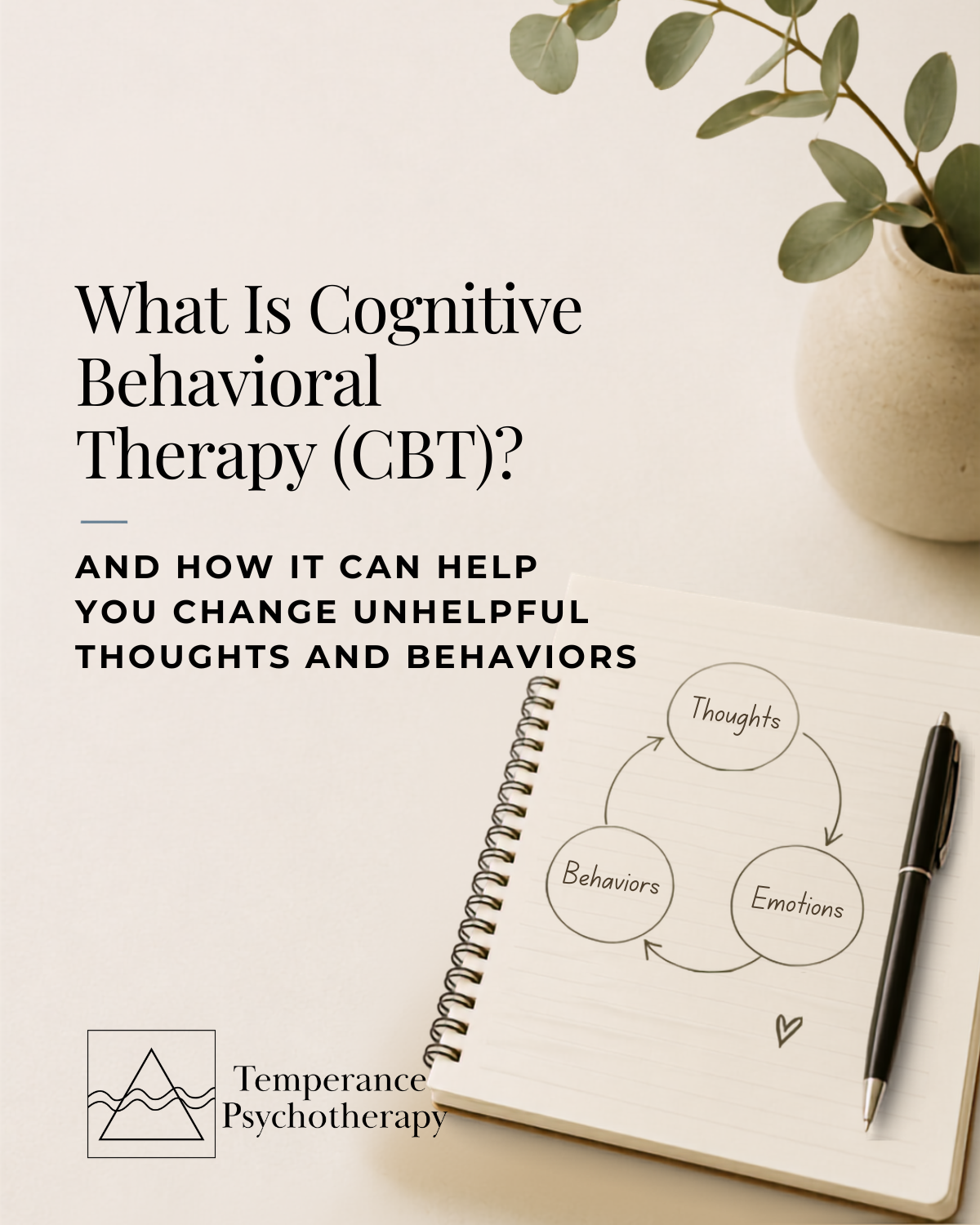
Our thoughts, emotions, behaviors, and physical sensations all influence one another.
For example:
A stressful situation may lead to an automatic thought:
"I'm going to fail."
That thought might create anxiety.
The anxiety could lead you to avoid the situation altogether.
Avoidance may provide temporary relief, but it often strengthens the original fear over time.
CBT helps interrupt this cycle by identifying patterns that no longer serve you and developing healthier, more effective ways of responding.
Rather than focusing only on insight, CBT emphasizes practicing new skills between sessions so that changes begin to carry over into everyday life.
What Conditions Can CBT Help Treat?
CBT has been shown to be effective for many mental health concerns, including:
Panic attacks
OCD (often alongside Exposure and Response Prevention)
Social anxiety
Perfectionism
Low self-esteem
Stress management
Health anxiety
Insomnia
Anger management
While CBT can be incredibly effective, it isn't always the only treatment needed. For example, OCD is typically treated most effectively using Exposure and Response Prevention (ERP), while emotion regulation difficulties may benefit from Dialectical Behavior Therapy (DBT) skills. One of the benefits of working with a therapist trained in multiple approaches is that treatment can be tailored to your specific concerns.
Common CBT Techniques
CBT includes many practical tools. Depending on your goals, your therapist may introduce techniques such as:
Identifying Automatic Thoughts
Many thoughts happen so quickly that we don't even notice them. CBT teaches you to slow down and recognize these automatic reactions.
Challenging Cognitive Distortions
Our brains naturally take shortcuts that can sometimes lead us to inaccurate conclusions.
Examples include:
Catastrophizing
All-or-nothing thinking
Mind reading
Fortune telling
Overgeneralization
Emotional reasoning
Learning to recognize these patterns helps create more balanced thinking without forcing unrealistic optimism.
Behavioral Experiments
Instead of simply debating whether a thought is true, CBT often encourages testing beliefs through real-life experiences.
For example:
"If I speak up in the meeting, everyone will think I'm incompetent."
Rather than accepting that prediction as fact, you and your therapist might create a small experiment to gather actual evidence.
Behavioral Activation
When people feel depressed, they often withdraw from activities that once brought meaning or enjoyment.
Behavioral activation helps gradually increase engagement in daily life, which can improve mood and motivation over time.
What Happens During CBT Sessions?
CBT is typically collaborative and structured.
Sessions often include:
Reviewing how things have been since the previous session
Identifying situations that felt difficult
Exploring thoughts, emotions, and behaviors involved
Learning new coping skills
Developing small, realistic goals to practice before the next session
Homework is common in CBT, but it doesn't look like schoolwork.
It might involve noticing thought patterns, practicing a coping skill, completing a worksheet, or trying a new behavior between sessions. These exercises help therapy become something you actively apply in daily life rather than something that only happens once a week.
Does CBT Ignore the Past?
One common misconception is that CBT only focuses on the present.
While CBT often emphasizes current patterns, understanding where those patterns came from can still be valuable.
For many people, early experiences shaped the beliefs they now hold about themselves, other people, and the world. Exploring those experiences can help make sense of why certain thoughts developed in the first place.
In my practice, I often integrate CBT with insight-oriented therapy, allowing us to understand both why a pattern developed and how to begin changing it.
Is CBT Right for Everyone?
CBT is supported by decades of research and is considered a first-line treatment for many mental health conditions.
That said, no single therapy approach is the best fit for every person.
Some people benefit from combining CBT with:
Acceptance and Commitment Therapy (ACT)
Dialectical Behavior Therapy (DBT)
Exposure and Response Prevention (ERP)
Insight-oriented therapy
The goal isn't to force every client into one model. It's to use the approaches that best fit your individual goals, personality, and concerns.
Frequently Asked Questions
-
No. CBT is not about pretending everything is okay or replacing every negative thought with a positive one. Instead, it focuses on developing more accurate, balanced, and helpful ways of thinking.
-
Many CBT treatment plans range from several weeks to several months, though this varies depending on your goals, symptoms, and whether CBT is combined with other therapy approaches.
-
Yes. CBT is considered one of the most effective treatments for anxiety disorders and is recommended by many professional organizations.
-
CBT principles are important, but OCD is generally treated most effectively using Exposure and Response Prevention (ERP), a specialized form of CBT designed specifically for OCD.
-
Probably not, and that's okay. The goal isn't to eliminate negative thoughts altogether. It's to change your relationship with them so they have less influence over your emotions and behavior.
Looking for CBT Therapy in Longwood or Maitland, FL?
If you're feeling stuck in patterns of anxiety, depression, perfectionism, OCD, or chronic self-criticism, CBT can provide practical tools to help you move forward.
At Temperance Psychotherapy, I offer individualized therapy for children, teens, and adults in Longwood and Maitland, Florida, as well as virtual therapy throughout Florida. Treatment is always tailored to your unique needs and may integrate CBT with ERP, DBT, ACT, and other evidence-based approaches.
Sources
The information in this article is based on current research and evidence-based clinical practice. If you'd like to learn more about CBT, these resources provide reliable, evidence-based information:
• American Psychological Association
• The National Institute of Mental Health
• The Association for Behavioral and Cognitive Therapies (ABCT)
