
What Is ERP? A Beginner's Guide to Exposure and Response Prevention Therapy
QUICK ANSWER:
What is ERP?
If you've been told that Exposure and Response Prevention (ERP) is the gold standard treatment for OCD, you may be wondering what that actually means.
ERP is a specialized form of cognitive behavioral therapy that helps people gradually face situations that trigger anxiety while resisting the urge to perform compulsions or seek reassurance. Over time, the brain learns that anxiety naturally decreases without relying on compulsions, allowing OCD to lose its grip.
Unlike simply talking about OCD, ERP focuses on changing the cycle that keeps OCD alive.
Many people living with OCD spend years trying to make their intrusive thoughts go away. They may avoid certain situations, seek reassurance from loved ones, or perform rituals that provide temporary relief. While these strategies can help in the moment, they often end up strengthening OCD over time.
If you've been researching treatment, you've probably come across Exposure and Response Prevention (ERP) and wondered what it actually involves. The name alone can sound intimidating, but ERP isn't about forcing yourself into frightening situations or simply "facing your fears." It's a structured, evidence-based approach that helps you break free from the cycle that keeps OCD going.
In this guide, you'll learn what ERP is, how it works, what to expect in therapy, and why it is considered the gold standard treatment for obsessive-compulsive disorder. Whether you're exploring treatment for yourself, your child, or someone you care about, my hope is that you'll leave with a better understanding of what recovery can look like.
What Is Exposure and Response Prevention (ERP)?
Exposure and Response Prevention, often called ERP, is the most researched and effective psychological treatment for obsessive-compulsive disorder (OCD).
OCD is maintained by a cycle:
An intrusive thought, image, feeling, or urge appears.
Anxiety or distress increases.
A compulsion is performed to feel better.
Relief occurs temporarily.
The brain learns that the compulsion "worked," making OCD stronger over time.
ERP interrupts this cycle.
Rather than trying to eliminate intrusive thoughts, ERP teaches your brain that you can experience uncertainty, discomfort, and anxiety without responding to OCD.
Over time, the anxiety becomes less intense, and OCD begins to lose its power.
Understanding the OCD Cycle
Imagine someone has the intrusive thought:
"What if I accidentally contaminated my family?"
They might:
Wash their hands repeatedly
Avoid touching certain objects
Ask loved ones for reassurance
Mentally review everything they touched
These behaviors temporarily reduce anxiety.
Unfortunately, they also teach the brain:
"Good thing you did that... otherwise something bad might have happened."
ERP helps break this learning pattern.
What Happens During ERP?
Many people hear the word "exposure" and immediately worry they'll be forced into their biggest fears.
That's not how good ERP works.
Treatment is collaborative and gradual.
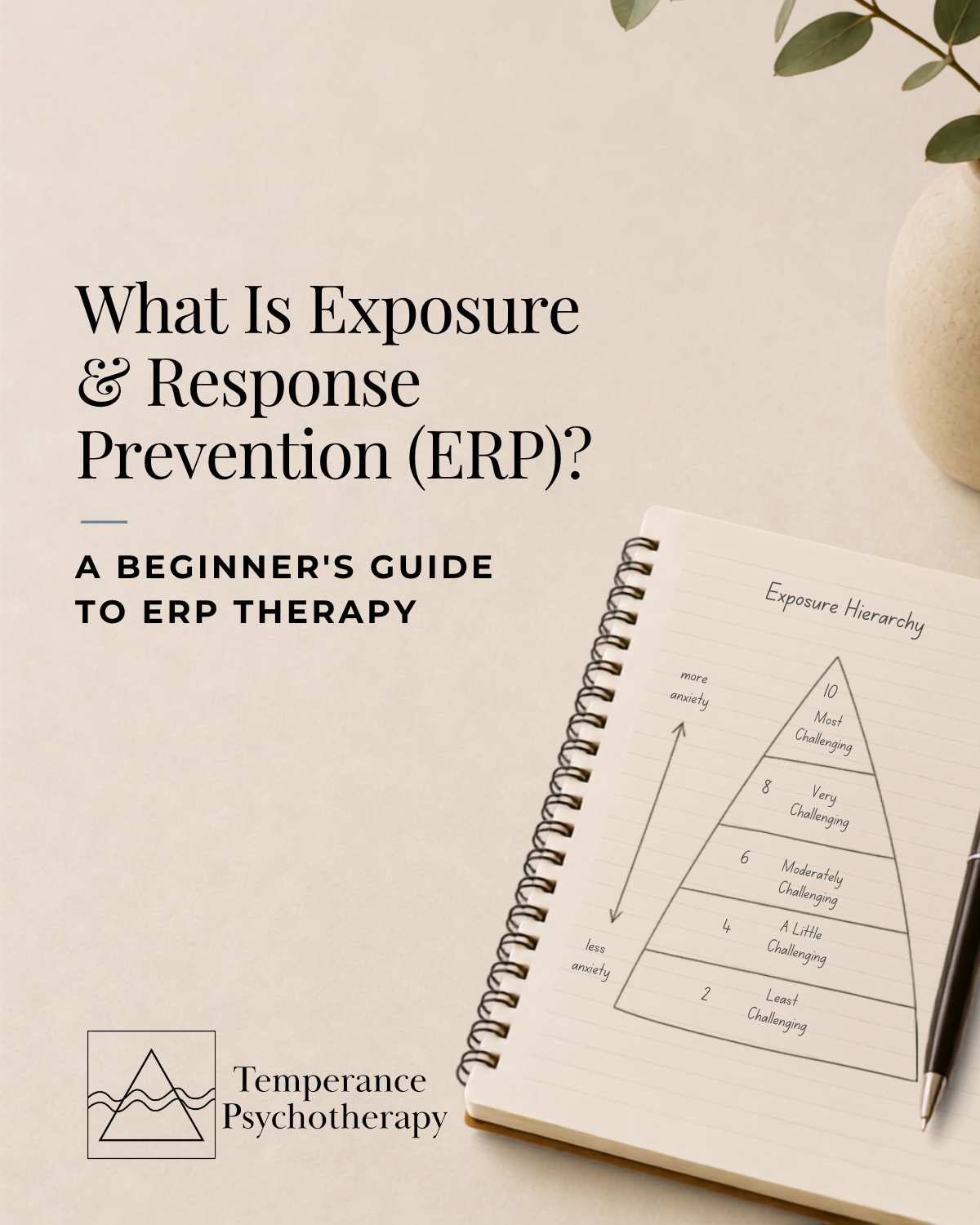
Together, you and your therapist identify situations that trigger OCD and create a hierarchy from least to most anxiety-provoking.
You begin practicing exposures that feel challenging but manageable while resisting compulsions.
As your confidence grows, you gradually work your way up the hierarchy.
ERP isn't about proving that your fears are impossible.
It's about learning that you can tolerate uncertainty without OCD making your decisions.
Does ERP Mean I Have to Face My Worst Fear?
No.
ERP should never feel like being thrown into the deep end without support.
A well-trained ERP therapist helps you move at a pace that is challenging enough for learning to occur while still feeling manageable.
The goal is not to overwhelm you.
The goal is to help your brain build new learning through repeated practice.
Does ERP Make Anxiety Worse?
In the short term, anxiety usually increases during an exposure.
That is actually part of how treatment works.
Instead of escaping anxiety through compulsions, your brain learns something new:
"I can handle this feeling, and it eventually comes down on its own."
Over time:
Anxiety often becomes less intense.
Intrusive thoughts become less believable.
Compulsions become easier to resist.
Daily life feels less controlled by OCD.
Many clients describe this as getting their life back.
Is ERP Effective?
Yes.
ERP has been studied for decades and is considered the first-line psychological treatment for OCD by organizations including the International OCD Foundation and the American Psychiatric Association.
Research consistently shows that most people experience meaningful improvement when they participate in ERP with a trained therapist and practice skills between sessions.
Common Types of OCD ERP Can Help Treat
ERP can be effective for many forms of OCD, including:
Contamination OCD
Harm OCD
Relationship OCD (ROCD)
Scrupulosity (religious or moral OCD)
Sexual orientation OCD
Pedophilia OCD (POCD)
Health anxiety when OCD-related
Existential OCD
Symmetry and "just right" OCD
Checking compulsions
Mental compulsions
Reassurance seeking
No matter what theme OCD takes, the underlying treatment principles remain the same.
Is ERP the Same as CBT?
ERP is actually a specialized type of Cognitive Behavioral Therapy (CBT).
While CBT often focuses on identifying and changing thinking patterns, ERP specifically targets the behaviors that keep OCD going.
Many therapists integrate CBT concepts into ERP, but ERP remains the treatment with the strongest evidence for OCD.
What If I'm Not Ready for ERP?
Feeling nervous about starting ERP is completely normal.
Most people don't begin therapy excited about facing their fears.
A good therapist will spend time helping you understand OCD, build coping skills, and create a treatment plan that feels collaborative rather than overwhelming.
The goal is never perfection.
It's helping you reclaim the parts of your life that OCD has taken away.
Frequently Asked Questions
-
No. ERP can help people with mild, moderate, or severe OCD. Starting treatment earlier often prevents OCD from becoming more disruptive over time.
-
Usually, yes.
Most progress happens through practicing ERP skills between sessions. Your therapist will help you create exercises that fit your goals and feel achievable.
-
Yes.
ERP is considered the first-line treatment for OCD in children, adolescents, and adults, with treatment tailored to each person's developmental level.
-
Everyone is different.
Some people notice meaningful improvement within a few months, while others benefit from longer-term therapy depending on symptom severity and other concerns like anxiety, depression, or trauma.
Ready to Start OCD Treatment?
Living with OCD can be exhausting, but it is also highly treatable.
At Temperance Psychotherapy, I provide evidence-based ERP therapy for children, teens, and adults struggling with OCD and anxiety in Longwood and Maitland, Florida and virtually throughout Florida.
If you're ready to learn how to step out of the OCD cycle and start building confidence in the face of uncertainty, I'd love to help.
Sources
The information in this article is based on current research and evidence-based clinical practice. If you'd like to learn more about ERP, these resources provide reliable, evidence-based information:
• American Psychological Association
• International OCD Foundation (IOCDF)
• The Association for Behavioral and Cognitive Therapies (ABCT)
