
What Is the ComB Model for Hair Pulling and Skin Picking?
QUICK ANSWER:
What is the ComB model?
The Comprehensive Behavioral Model (ComB) is an individualized approach to treating body-focused repetitive behaviors (BFRBs) such as hair pulling (trichotillomania) and skin picking (excoriation disorder).
Instead of assuming that everyone pulls or picks for the same reason, ComB helps us investigate the specific sensations, thoughts, emotions, movements, and environments that contribute to your behavior.
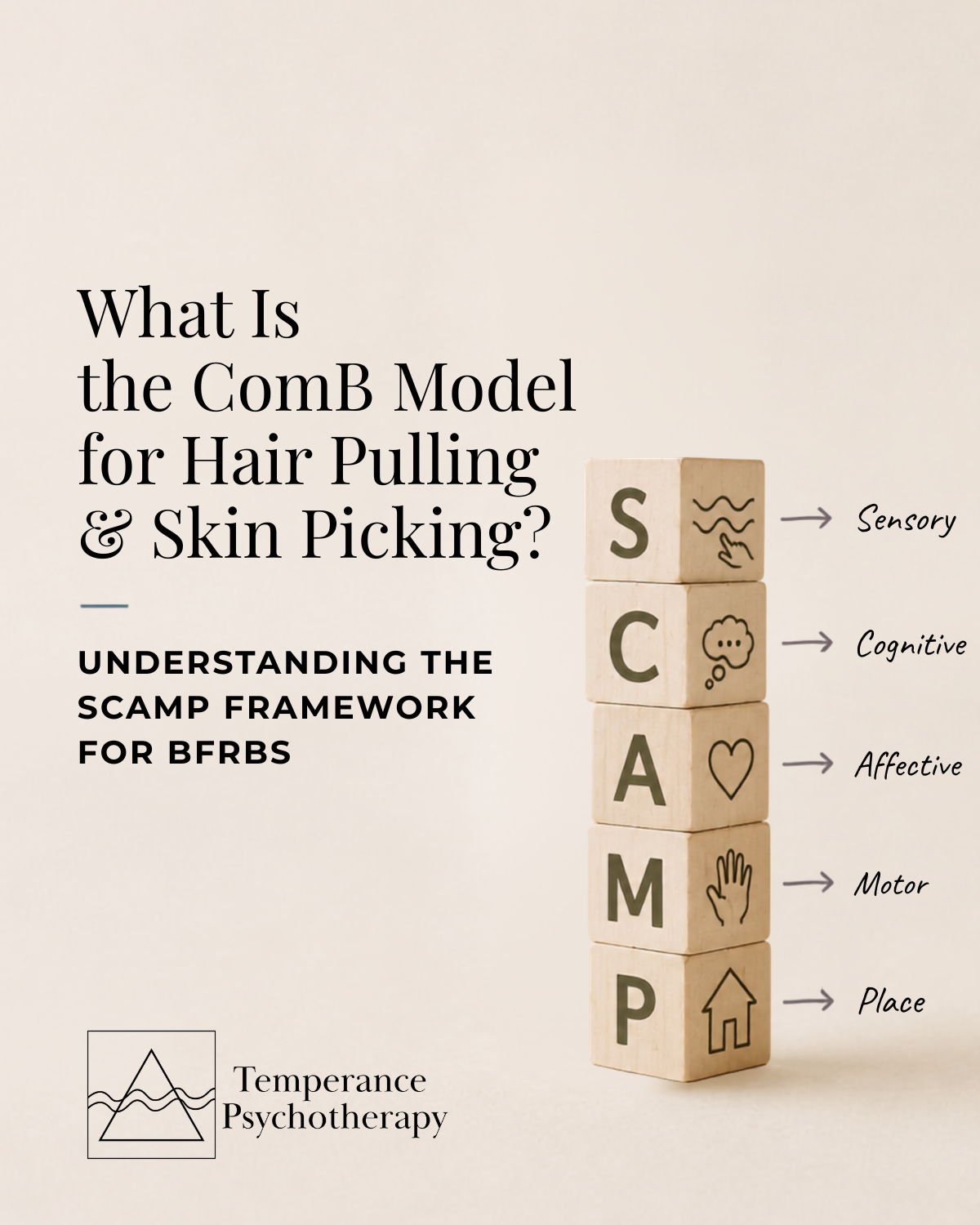
These five areas make up the acronym SCAMP: Sensory, Cognitive, Affective, Motor, and Place.
Once we understand your unique pattern, we can choose strategies that actually address what is keeping the behavior going.
If you've ever tried to stop pulling your hair or picking your skin, you've probably heard plenty of suggestions:
“Keep your hands busy.”
“Wear gloves.”
“Use a fidget.”
“Just try not to touch it.”
And sometimes those strategies help!
But sometimes they don't.
That's because two people can engage in the exact same behavior for completely different reasons.
One person might pull their hair because they're searching for strands that feel coarse or “wrong.” Another might automatically pull while watching TV. Someone else may notice that pulling helps them regulate anxiety or gives their hands something to do when they're bored.
Same behavior. Completely different patterns.
The ComB Model helps us figure out what your pattern looks like.
What Is the ComB Model?
ComB stands for Comprehensive Behavioral Model.
It was developed by Dr. Charles Mansueto and colleagues as a framework for understanding and treating body-focused repetitive behaviors (BFRBs), particularly trichotillomania and skin picking disorder.
Rather than using a one-size-fits-all approach, ComB starts with a functional assessment.
In other words, we get curious.
We look at:
What happens before you pull or pick?
What does the urge feel like?
Where does it usually happen?
What are you thinking?
What are you feeling?
What are your hands doing?
What does pulling or picking accomplish in that moment?
What happens afterward?
The goal is to create your individual BFRB profile.
Once we understand what's contributing to the behavior, we can choose interventions specifically designed for those triggers.
Why Do People Pull Their Hair or Pick Their Skin?
There's usually not one simple answer.
BFRBs can serve different functions at different times.
You might pull because a hair feels “wrong.”
You might pick because you see a bump in the mirror and suddenly feel like you have to make your skin smooth.
You might start pulling without noticing while watching Netflix.
You might pick when you're stressed.
Or bored.
Or trying to fall asleep.
Or concentrating on homework.
You may even notice that several of these things are true.
ComB gives us a framework for organizing all of that information using something called SCAMP.
What Does SCAMP Mean?
SCAMP represents five areas that can contribute to hair pulling, skin picking, and other BFRBs:
S — Sensory
C — Cognitive
A — Affective
M — Motor
P — Place
Think of these as five different sets of clues.
When we understand which clues are most relevant to your BFRB, it becomes much easier to figure out what interventions might actually help.
Let's break them down.
S: Sensory
The Sensory domain focuses on what you see, touch, or physically experience before, during, and after the behavior.
For someone who pulls their hair, sensory triggers might include:
A coarse or wiry hair
A strand that feels thicker than the others
A bent or uneven eyelash
An itchy or tingling sensation on the scalp
The sensation of pulling the hair
Touching or examining the root afterward
For someone who picks their skin, it might involve:
Feeling a bump
Seeing a blemish
Running your fingers over uneven skin
Feeling a scab or dry patch
Wanting the skin to feel completely smooth
Enjoying the sensation associated with picking
This is why simply replacing pulling or picking with a random fidget doesn't always work.
If the behavior is meeting a very specific sensory need, we may need to find an alternative that addresses that particular sensation.
C: Cognitive
The Cognitive domain looks at the thoughts, beliefs, and mental rules surrounding the behavior.
Thoughts might sound like:
“That hair doesn't belong there.”
“I just need to get this one.”
“My skin will look better once I get rid of this bump.”
“I can't leave it like that.”
“I'll stop after I find the right one.”
Sometimes these thoughts create a sense of urgency or incompleteness that makes resisting the behavior especially difficult.
Treatment may involve noticing these thoughts, questioning rigid rules, practicing tolerating imperfection, or learning how to respond differently without automatically acting on them.
A: Affective
Affective simply means emotions.
For some people, pulling or picking is closely connected to emotional states such as:
Anxiety
Stress
Frustration
Sadness
Overwhelm
Excitement
Boredom
The behavior may temporarily soothe an uncomfortable feeling, or provide stimulation when someone feels understimulated.
For example, someone may notice:
Stress → urge to pull → pulling → temporary relief
That relief can reinforce the behavior, teaching the brain that pulling is an effective way to regulate stress.
If emotion regulation is an important part of someone's BFRB pattern, treatment may include strategies for managing those emotions in other ways.
M: Motor
The Motor domain looks at the physical movements and body positions associated with the behavior.
Sometimes your body learns the habit so well that your hands seem to start moving before you've consciously decided to do anything.
For example:
You're lying in bed scrolling on your phone.
One hand is holding the phone.
The other hand wanders toward your eyelashes.
You start touching them.
Then searching.
Then pulling.
You may barely notice the process happening.
We look for things like:
Where your hands tend to rest
How your fingers move before pulling or picking
Whether you scan your hair or skin
What body positions make the behavior easier
Whether the behavior happens automatically
Once we identify those patterns, we can experiment with ways to interrupt the sequence earlier.
P: Place
Finally, we look at Place, which is your environment.
BFRBs often become strongly associated with particular locations, activities, or situations.
Common examples include:
Lying in bed
Sitting on the couch
Watching TV
Driving
Doing homework
Working at a computer
Looking in a bathroom mirror
Being alone
Reading
Using a phone
You might even discover something like:
“I almost never pull during the day. It happens almost exclusively when I'm lying in bed trying to fall asleep.”
That's extremely useful information!
Rather than spending all day trying to prevent pulling, we can focus much more specifically on the environment where the behavior actually occurs.
Putting SCAMP Together: Becoming a BFRB Detective
Here's where ComB becomes especially helpful.
Imagine someone who pulls their eyelashes.
Through our detective work, we discover:
Sensory: They search for eyelashes that feel bent or uneven.
Cognitive: They think, “That lash isn't right. I need to get it out.”
Affective: They're usually bored rather than anxious.
Motor: Their hand automatically moves toward their eyes when they're lying still.
Place: Pulling happens almost exclusively while lying in bed before falling asleep.
Suddenly, “just stop pulling” isn't our treatment plan anymore.
We have clues.
Now we can develop strategies specifically targeting those clues.
That's the heart of ComB.
What Does ComB Treatment Actually Look Like?
The first part of treatment often involves assessment and self-monitoring.
We become detectives together.
You might start noticing:
Where was I?
What was I doing?
What did I notice first?
What did my body feel like?
What was I thinking?
What was I feeling?
What happened next?
Once patterns begin to emerge, we identify the SCAMP areas that seem most relevant.
Then we experiment with interventions.
The word experiment is important.
We aren't expecting every strategy to work perfectly.
Instead, we're asking:
Did this help?
What happened when we tried it?
What should we change?
What else could we try?
Treatment becomes a collaborative process of understanding the behavior, testing strategies, and adjusting based on what we learn.
Is ComB the Same as Habit Reversal Training (HRT)?
Not exactly, but they do work very well together.
Habit Reversal Training (HRT) typically focuses on increasing awareness of the behavior and learning a competing response that makes pulling or picking more difficult.
ComB expands the assessment by looking more closely at the different factors contributing to the behavior across the SCAMP domains.
You can think of HRT as giving us some important tools.
ComB helps us figure out which tools we might need, when we need them, and why.
In practice, treatment for BFRBs may incorporate strategies from both approaches.
Does ComB Work for Children and Teens?
Yes. And the detective framework can work especially well with younger clients.
Instead of asking a child to complete a lengthy clinical assessment, we can make the process much more concrete.
We might become “BFRB Detectives” together and look for clues.
What was your hand doing?
What did the hair feel like?
Where were you?
Were you bored, worried, tired, or something else?
What happened right before you noticed yourself pulling?
With children, I may incorporate games, drawing, visual aids, sensory exploration, or other play-based activities while we're gathering information.
The clinical goal is the same.
The presentation just looks different.
What If I Don't Know Why I Pull or Pick?
That's completely okay.
You don't need to walk into therapy already knowing your triggers.
In fact, figuring that out is part of the work.
Many BFRBs happen automatically, meaning someone may not realize they're pulling or picking until they've already been doing it.
Other BFRBs are more focused, meaning the person is very aware of what they're doing and may be intentionally searching for a particular hair, bump, scab, or sensation.
Some people experience both.
ComB gives us a structured way to slow the process down and start noticing patterns that weren't obvious before.
Does ComB Mean I Have to Stop Pulling or Picking Completely?
Not necessarily.
Treatment goals are individualized too.
For some people, the goal may eventually be stopping the behavior.
For someone else, early goals might include:
Becoming more aware of automatic pulling or picking
Reducing the frequency of the behavior
Reducing physical damage
Shortening picking or pulling episodes
Learning to tolerate urges without immediately responding
Feeling more in control of the behavior
Reducing shame surrounding the BFRB
Success doesn't have to mean perfection.
Frequently Asked Questions
-
No. Although ComB was originally developed in connection with trichotillomania, the approach is now used for multiple body-focused repetitive behaviors, including hair pulling, skin picking, nail biting, lip biting, and cheek biting.
-
Yes. ComB is a cognitive-behavioral approach specifically designed to understand and treat body-focused repetitive behaviors.
-
ComB is grounded in established behavioral principles and has been developed and refined specifically for BFRBs. Research evaluating ComB has grown over time, although Habit Reversal Training (HRT) has historically had a larger research base.
-
No.
The goal isn't to fill every box.
One person may have strong Sensory and Place triggers while emotions play very little role.
Another person's behavior might be strongly connected to Affective and Motor factors.
That's exactly why we assess them individually.
Treatment should be tailored to the person.
-
It can be!
But ComB isn't simply about giving everyone a fidget toy.
If someone's BFRB is connected to needing sensory stimulation or keeping their hands occupied, a carefully selected sensory tool might be helpful.
If someone's main trigger is a rigid belief that every coarse hair needs to be removed, a fidget alone probably won't address the whole problem.
The intervention should match the trigger.
Ready to Better Understand Your Hair Pulling or Skin Picking?
If you've tried repeatedly to “just stop” pulling or picking without success, it may be time to approach the behavior differently.
At Temperance Psychotherapy, I use ComB, Habit Reversal Training (HRT), and other evidence-based behavioral approaches to help children, teens, and adults better understand and manage body-focused repetitive behaviors.
Rather than assuming we already know why the behavior happens, we'll get curious about your specific patterns and figure it out together.
I provide BFRB therapy in Longwood and Maitland, Florida, as well as virtually throughout Florida.
Request an appointment or free consultation to get started.
