
What Is Habit Reversal Training (HRT)? A Beginner’s Guide for Hair Pulling, Skin Picking, and Other Habits
QUICK ANSWER:
What is HRT?
Habit Reversal Training (HRT) is an evidence-based behavioral therapy that helps people become more aware of repetitive behaviors and learn new ways to respond to the urge to do them.
HRT is commonly used to treat body-focused repetitive behaviors (BFRBs) such as hair pulling (trichotillomania), skin picking (excoriation disorder), and nail biting. It can also be helpful for other repetitive habits and tic-related behaviors.
Rather than simply telling someone to “just stop,” HRT focuses on understanding when, where, and why the behavior happens and building practical strategies that make it easier to interrupt the pattern.
If you've ever tried to stop picking your skin, pulling your hair, biting your nails, or engaging in another repetitive habit, you've probably discovered something frustrating:
Knowing you want to stop doesn't necessarily make it easy to stop.
Sometimes you don't even realize you're doing it until several minutes have passed. Other times, you're very aware of the urge…but it feels almost impossible to ignore.
That's where Habit Reversal Training (HRT) comes in.
HRT is a structured, evidence-based behavioral treatment that helps you understand the patterns behind repetitive behaviors and gives you concrete tools for responding differently.
And importantly, it isn't based on shame, punishment, or simply trying harder.
What Is Habit Reversal Training (HRT)?
Habit Reversal Training was originally developed as a behavioral treatment for repetitive habits and has since become one of the best-established treatments for body-focused repetitive behaviors.
HRT is frequently used for behaviors such as:
Hair pulling (trichotillomania)
Skin picking (excoriation disorder)
Nail biting
Lip or cheek biting
Other body-focused repetitive behaviors (BFRBs)
Certain tics and repetitive habits
Although these behaviors may look simple from the outside, they can actually involve a complicated combination of sensory experiences, emotions, thoughts, environments, and learned habits.
That's why “just stop doing it” usually isn't very helpful.
HRT helps us slow the process down and figure out what's actually happening.
Understanding the Habit Loop
Many repetitive behaviors happen in a predictable pattern:
Something triggersthe behavior.
An urge or sensation appears.
The person engages in the behavior.
The behavior provides some type of relief, satisfaction, stimulation, or sense of completion.
The brain learns to repeat the pattern.
For example, someone who pulls their eyelashes might notice one that feels slightly different from the others.
They touch it.
It feels “bumpy” or “wrong.”
They keep checking it.
Eventually, they pull it.
For a moment, they feel relief.
That relief can reinforce the behavior, making it more likely that the same pattern happens again.
Other times, the process is much less conscious. Someone may start picking at their skin while watching TV or pulling their hair while lying in bed without realizing what they're doing.
HRT helps make these patterns more visible so we have more opportunities to interrupt them.
What Happens During Habit Reversal Training?
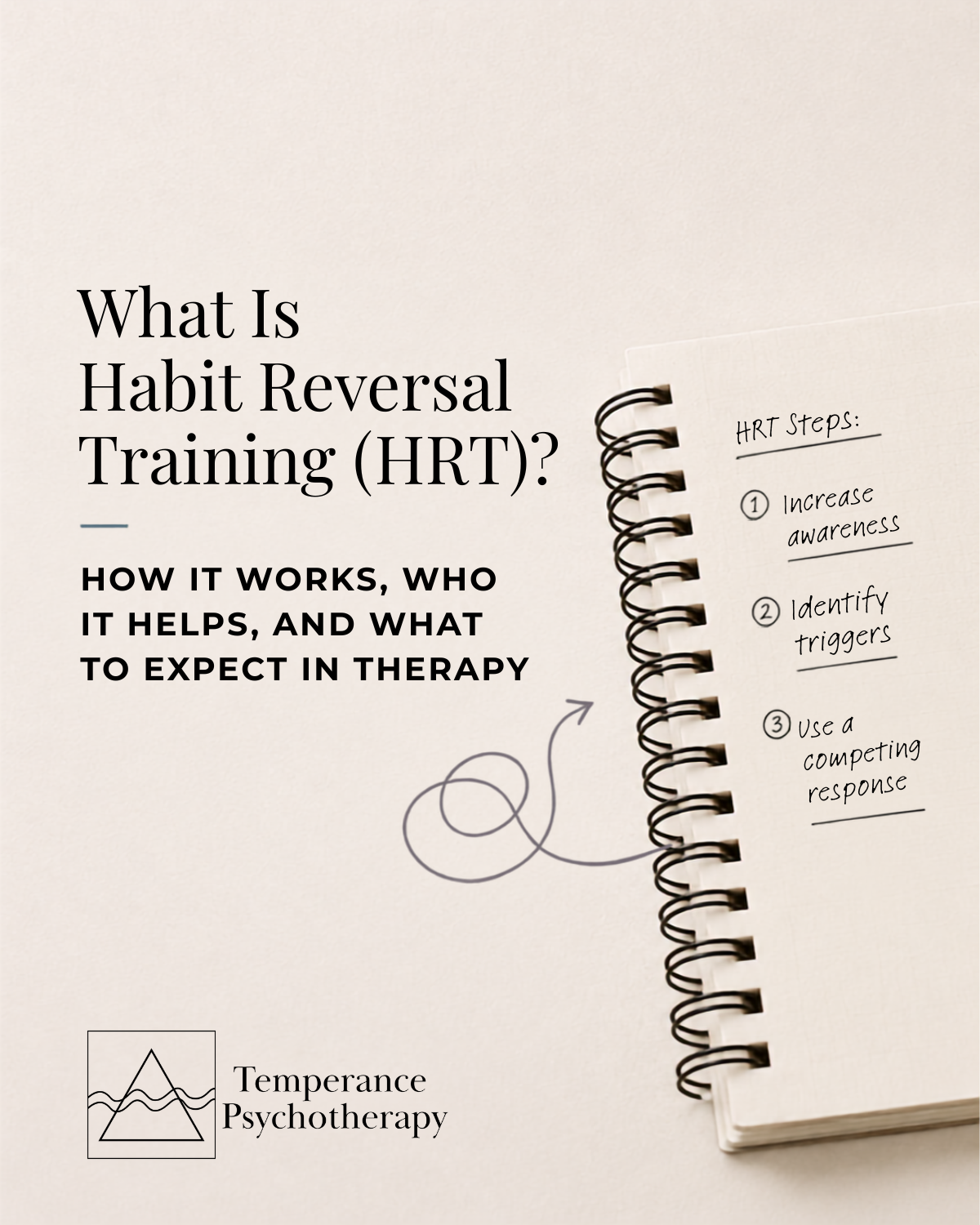
HRT typically includes several components, but two of the most important are awareness training and competing response training.
1. Awareness Training
Before we can change a habit, we have to notice it.
That sounds obvious, but many BFRBs happen almost automatically.
In therapy, we might start becoming curious about things like:
Where does the behavior usually happen?
What time of day is it most common?
What are you doing right before it happens?
What emotions tend to be present?
What physical sensations do you notice?
What does the urge feel like?
Are there certain textures, hairs, bumps, or imperfections you search for?
Does the behavior happen when you're bored? Anxious? Tired? Focused?
What happens immediately after you pull, pick, or bite?
The goal isn't to judge the behavior.
We're essentially becoming detectives and gathering information about how the habit works.
2. Competing Response Training
Once you become better at noticing the urge, the next step is learning what to do instead.
A competing response is a behavior that makes it difficult or impossible to perform the BFRB at the same time.
For example, depending on the behavior and situation, someone might:
Gently make a fist
Place their hands underneath their legs
Fold their hands together
Hold or manipulate another object
Use another movement that physically prevents the pulling, picking, or biting behavior
The specific competing response should be individualized.
The goal isn't simply to “distract yourself.”
It's to practice responding differently when the urge appears so that, over time, the old behavioral pattern becomes less automatic.
Is HRT Just About Using Fidget Toys?
Not exactly.
Fidgets, sensory tools, barriers, or other environmental changes can absolutely be helpful, but Habit Reversal Training is more than handing someone a stress ball and hoping they stop picking.
Effective treatment involves understanding what function the behavior is serving.
For one person, hair pulling may happen primarily when they're bored.
For someone else, it may happen when they're anxious.
Another person might search for hairs that feel coarse, bent, or “not right.”
Someone else may pull almost exclusively while falling asleep.
Those are very different patterns, which means they may require very different interventions.
This is also why I often incorporate concepts from the Comprehensive Behavioral Model (ComB) when treating BFRBs. ComB allows us to look more closely at the sensory, cognitive, emotional, motor, and environmental factors that contribute to the behavior and tailor treatment accordingly.
What Is the Difference Between HRT and ComB?
HRT and ComB are closely related behavioral approaches, and they are often used together.
Habit Reversal Training focuses heavily on increasing awareness of the behavior and practicing competing responses when urges occur.
ComB (Comprehensive Behavioral Treatment) expands the detective work even further by asking what specific factors are driving the behavior for that individual.
For example, we may explore:
Sensory: Does a particular texture or sensation trigger the behavior?
Cognitive: Are there certain thoughts or rules involved?
Emotional: Does the behavior help regulate boredom, stress, anxiety, or frustration?
Motor: What movements or body positions make the behavior easier?
Environmental: Where and when is the behavior most likely to happen?
Instead of assuming that everyone's hair pulling or skin picking works the same way, treatment becomes highly individualized.
Does HRT Mean I Have to Completely Stop Pulling or Picking?
Treatment goals can vary.
For some people, the goal is significantly reducing or stopping the behavior. For others, treatment may initially focus on increasing awareness, reducing physical damage, interrupting certain patterns, or feeling more in control of how they respond to urges.
One of the most important parts of BFRB treatment is reducing shame.
Hair pulling and skin picking aren't signs that someone is lazy, lacking willpower, or “just not trying hard enough.”
These are learned behavioral patterns that can become incredibly automatic and reinforcing.
Therapy focuses on understanding the pattern and building skills, not criticizing yourself for having it.
Is Habit Reversal Training Effective?
Yes. HRT has been studied for decades and has one of the strongest evidence bases among behavioral treatments for BFRBs such as trichotillomania and excoriation disorder.
Research supports awareness training and competing response training as particularly important components of HRT.
Treatment can also incorporate other evidence-based approaches depending on the individual, including ComB, Acceptance and Commitment Therapy (ACT), Dialectical Behavior Therapy (DBT), and stimulus-control strategies.
The goal isn't necessarily to find one perfect technique.
It's to understand your specific pattern and build a treatment plan around it.
Can HRT Help Children and Teens?
Yes.
Habit Reversal Training can be adapted for children and adolescents in developmentally appropriate ways.
With younger clients especially, therapy doesn't have to feel like sitting across from a therapist answering questions for an hour.
We might play games while talking about urges, become “BFRB detectives,” draw out the habit cycle, experiment with different sensory tools, or create visual reminders for riding out urges.
Parents can also be an important part of treatment.
The goal is to help parents support skill use without constantly monitoring, correcting, or calling attention to the behavior, which can sometimes increase shame or tension.
What Does HRT Look Like in Therapy?
Treatment is collaborative and individualized.
Early sessions often involve figuring out exactly how the behavior works.
We might track patterns, identify triggers, explore sensory experiences, and notice the moments immediately before the behavior occurs.
From there, we experiment.
Which competing responses actually feel realistic?
Would changing something in the environment help?
Is the behavior happening automatically or intentionally?
Does the person need more sensory stimulation—or less?
Are emotions contributing to the urge?
Treatment becomes an ongoing process of noticing patterns, testing strategies, and adjusting based on what we learn.
The goal isn't perfection.
It's helping the behavior feel less automatic, less powerful, and more manageable.
Frequently Asked Questions
-
No. HRT can be used for a variety of repetitive behaviors, including hair pulling, skin picking, nail biting, lip or cheek biting, tics, and other habitual behaviors.
-
Trichotillomania and excoriation disorder are classified as obsessive-compulsive and related disorders, but they aren't the same thing as OCD.
The behaviors may sometimes look similar from the outside, but the internal experience and treatment approach can be different. That's why getting an accurate assessment is important.
-
No (or at least, that's not what effective BFRB treatment should look like).
Most people struggling with BFRBs have already tried telling themselves to stop.
HRT focuses on understanding what drives the behavior and developing realistic strategies for responding differently.
-
Tracking can be useful, but it should be clinically helpful, not another source of stress or perfectionism.
For some people, detailed tracking provides valuable information. For others, we may use simpler ways of identifying patterns.
Treatment should be tailored to the person.
-
There isn't one set timeline.
Some people notice changes relatively quickly once they identify their triggers and find effective competing responses. Others benefit from longer-term work, particularly when the behavior has been present for years or is influenced by multiple sensory, emotional, and environmental factors.
Ready to Get Help for Hair Pulling, Skin Picking, or Other BFRBs?
If you've spent months (or even years) telling yourself to “just stop,” therapy can offer a different approach.
At Temperance Psychotherapy, I provide evidence-based treatment for trichotillomania, skin picking, and other body-focused repetitive behaviors using Habit Reversal Training (HRT), ComB, and other behavioral approaches tailored to each client's individual patterns.
I work with children, teens, and adults in Longwood and Maitland, Florida, as well as virtually throughout Florida.
Instead of focusing on willpower or shame, we'll get curious about what keeps the behavior going and build practical strategies that actually fit your life.
Request an appointment or free consultation to get started.
Sources
The information in this article is based on current research and evidence-based clinical practice. Research on Habit Reversal Training supports its use for body-focused repetitive behaviors, with awareness training and competing response training among its core components.
