Homeschooling and ADHD: How to Build Weekly Structure Without Recreating School
One of the benefits of homeschooling is the freedom to create a learning environment that works for your child, not simply reproducing a traditional classroom at home.
For children and teens with ADHD, that flexibility can be especially valuable. A homeschool schedule can allow for movement, interest-based learning, shorter work periods, and breaks when they are genuinely needed.
At the same time, too little structure can create its own challenges. Without clear routines and external cues, students with ADHD may struggle to begin assignments, estimate how long tasks will take, remember responsibilities, or transition between activities.
The goal is not to schedule every minute of the day. It is to create enough predictability that your child knows what to expect while preserving the flexibility that may have drawn your family to homeschooling in the first place.
Why Structure Can Be Helpful for Students With ADHD
ADHD affects more than attention. It can also affect executive functioning skills, including:
Starting tasks
Organizing materials
Prioritizing responsibilities
Estimating and managing time
Remembering multi-step directions
Transitioning between activities
Regulating emotions when something feels difficult or boring
A student may fully understand what they need to do and still have trouble getting started. They may become deeply absorbed in a preferred activity and lose track of time, or avoid an assignment because it feels too large or unclear.
This is why repeated reminders such as “focus,” “try harder,” or “you know what you need to do” are often ineffective. Students with ADHD usually benefit more from having expectations made visible, tasks broken into manageable steps, and routines that reduce the number of decisions they must make throughout the day.
Structure should function as support, not punishment or constant surveillance.
Start With Weekly Anchors
Rather than building a rigid schedule for every hour, begin with a few consistent “anchors” that remain relatively predictable throughout the week.
These might include:
A regular wake-up range
A general time to begin schoolwork
Lunch
Extracurricular activities or appointments
A daily movement break
A consistent stopping point for academic work
Evening routines and bedtime
Anchors provide a basic rhythm without requiring every day to look identical.
For example, a family might decide that academic work generally begins between 9:00 and 9:30 a.m., lunch happens around noon, and structured schoolwork ends by 2:00 p.m. The subjects, breaks, and activities within that time can still vary.
This tends to feel more manageable than trying to replicate a traditional school day from morning through afternoon.
Plan the Week Before Planning Each Day
Students with ADHD may have difficulty holding an entire week’s responsibilities in mind. A short weekly planning session can make upcoming expectations more concrete.
At the beginning of the week, review:
Assignments that must be completed
Tests, projects, or deadlines
Appointments and extracurricular activities
Social plans
Household responsibilities
Tasks that may require extra help
Opportunities for rest and enjoyable activities
Keep this meeting brief. The goal is not to create the perfect schedule; it is to help your child see what is coming and decide where larger tasks might fit.
Older children and teens should be included in this process. They may not independently create a realistic plan yet, but collaborative planning helps them gradually develop those skills.
Use Work Blocks Instead of Recreating Class Periods
A student with ADHD may not work effectively simply because they are seated at a desk for a predetermined amount of time.
Instead of copying a traditional school schedule, consider using shorter work blocks followed by intentional breaks. Depending on the student’s age and needs, this could look like:
15 minutes of work followed by a short movement break
25 minutes of focused work followed by a 5-minute break
One clearly defined task followed by a preferred activity
A longer focus block for a high-interest subject and shorter blocks for less-preferred work
The most helpful work period is not necessarily the longest one. It is the amount of time during which the student can engage productively without becoming overwhelmed or completely depleted.
A timer can help make time visible, but it should be used as a neutral support rather than a threat. Some students also benefit from a visual countdown, music playlist, or written checklist showing exactly what “finished” means.
Make the Schedule Visible
Verbal reminders disappear quickly. A visible plan gives the student something concrete to return to.
Depending on the child’s age, this might be:
A whiteboard with the day’s three main priorities
A printed weekly schedule
A checklist in a binder
A color-coded calendar
A shared digital calendar
Sticky notes that can be moved into a “done” column
Try to keep the system simple. A highly detailed planner may look helpful but quickly become another task the student has to maintain.
A useful daily plan might include only:
What must be completed today
What can be completed if there is time
What enjoyable activity or break is coming next
Whenever possible, write specific actions rather than broad categories. “Complete five math problems” is easier to begin than “do math.” “Read pages 20–30” is clearer than “work on English.”
Build in Movement Before It Is Needed
Movement does not have to be something a child earns after sitting still. For many students with ADHD, movement supports attention and emotional regulation.
Movement breaks might include:
Walking the dog
Jumping on a trampoline
Stretching
Dancing to one song
Shooting basketballs
Completing work while standing
Listening to an audiobook while walking
Changing work locations
It can be helpful to schedule movement between subjects or before a task that typically requires greater concentration.
Some students also focus better when they are allowed to move while learning. Sitting perfectly still is not the same as paying attention.
Create a Clear Beginning and Ending to the School Day
When school happens at home, the boundary between “school time” and personal time can become blurry. A student may feel as though unfinished work is always hanging over them, or that they could delay starting because there is technically time later.
Simple rituals can help signal the beginning and end of the academic day.
A beginning routine might involve:
Eating breakfast
Getting dressed
Reviewing the day’s plan
Choosing the first task
Setting up the workspace
An ending routine might involve:
Checking off completed tasks
Writing down what needs to carry over
Putting materials away
Previewing tomorrow’s first task
Physically leaving the work area
A defined stopping point is especially important. If work regularly stretches into the evening, it may be worth reassessing the workload, the length of assignments, or the level of support the student needs.
Offer Choices Within Clear Boundaries
Students with ADHD often respond well to having some autonomy, particularly when they have experienced frequent correction or conflict around schoolwork.
Choices might include:
“Would you like to start with math or science?”
“Do you want to work at the table or on the porch?”
“Would a written checklist or a timer be more helpful?”
“Do you want to take a break now or after the next two questions?”
The adult still defines the expectation, while the student has some control over how they approach it.
Too many choices can become overwhelming, so offering two realistic options is often more effective than asking an open-ended question such as, “What do you want to do today?”
Include Social Time in the Weekly Plan
Homeschooling can provide relief from stressful school environments, but children and teens still need regular opportunities to connect with peers.
Social interaction may come from:
Sports, dance, theater, or other extracurricular activities
Homeschool co-ops
Volunteer opportunities
Faith communities
Interest-based clubs
Regular meetups with friends
Online communities with appropriate supervision
Some students need help moving beyond simply being near other children and toward forming meaningful relationships. A teen may attend several activities each week and still feel lonely, disconnected, or unsure how to turn an acquaintance into a friendship.
Social time deserves a place in the weekly plan just as academic work does. It should not be treated only as a reward for completing schoolwork.
Expect the Plan to Need Adjustment
A helpful routine is not one that works perfectly every day. It is one that helps the family recover when the day does not go as planned.
Some weeks will include appointments, poor sleep, emotional overwhelm, illness, or assignments that take much longer than expected. Flexibility is not evidence that the structure has failed.
Instead of abandoning the entire plan, ask:
What part of the routine was helpful?
Where did the student get stuck?
Was the task clear and appropriately sized?
Was the workload realistic?
Were enough breaks built in?
Did the student need more support getting started?
Is this system simple enough to maintain?
Students with ADHD are often given the message that inconsistency means they are lazy, unmotivated, or not trying. A more useful approach is to treat difficulty as information. If a plan repeatedly breaks down in the same place, the student may need a different type of support—not more pressure.
When Homeschool Stress May Signal a Need for Additional Support
Even with a thoughtful routine, some children and teens continue to struggle with intense anxiety, emotional outbursts, persistent avoidance, low self-esteem, loneliness, or frequent conflict with caregivers.
Therapy may help when ADHD-related challenges begin to affect a young person’s mood, relationships, confidence, or ability to participate in daily life.
Support can focus on more than productivity. Depending on the student’s needs, therapy may help them:
Better understand how their brain works
Develop realistic planning and organizational strategies
Manage frustration and emotional overwhelm
Challenge negative beliefs about themselves
Practice self-advocacy
Build social confidence
Cope with anxiety, perfectionism, or school-related stress
Strengthen communication with caregivers
Finding a Rhythm That Works for Your Family
The purpose of a homeschool routine is not to make home look more like school. It is to create a sustainable rhythm that supports learning, emotional well-being, family relationships, and the student’s growing independence.
For many students with ADHD, the most effective structure is predictable but not rigid, visible but not overly complicated, and collaborative rather than imposed.
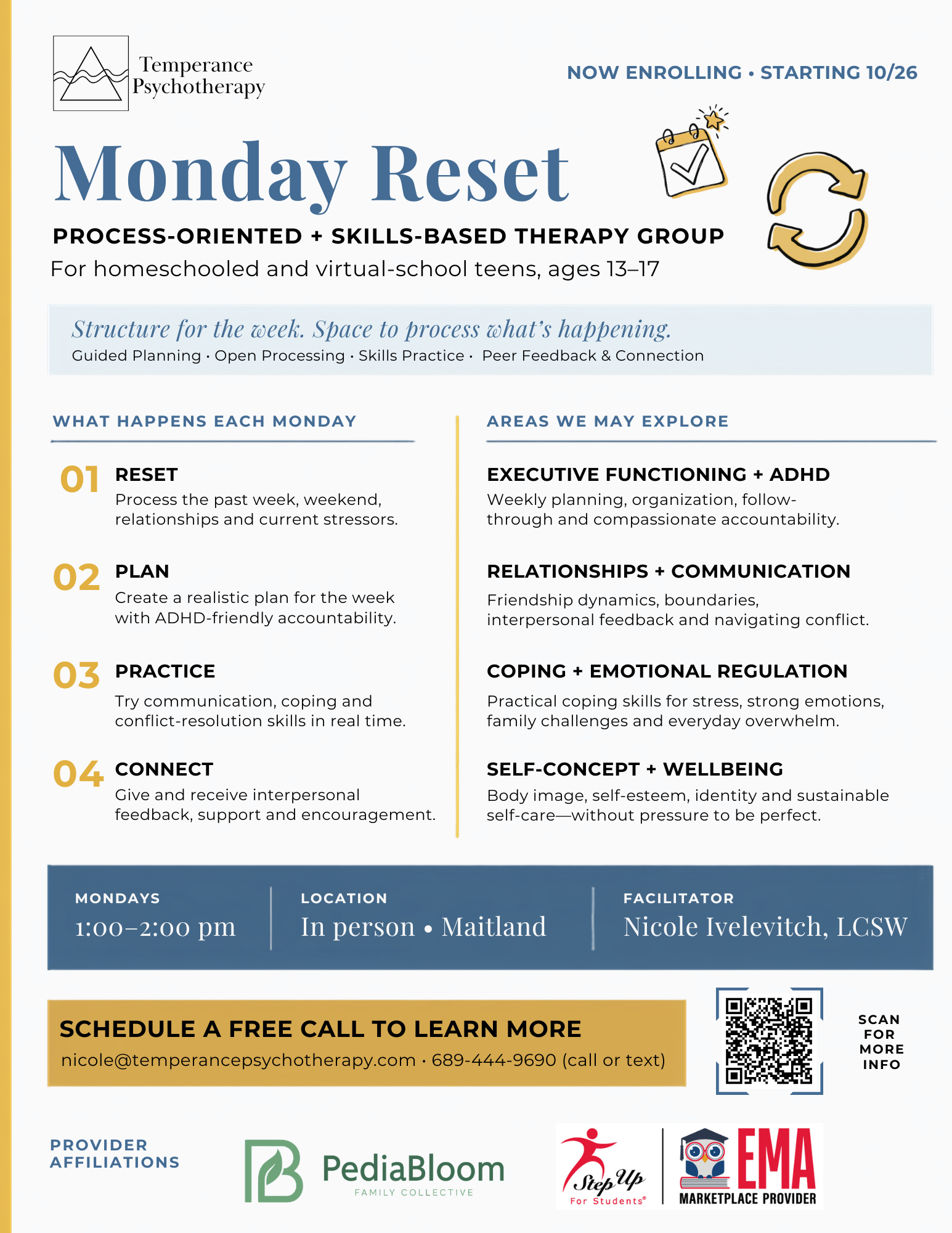
Temperance Psychotherapy provides therapy for children and teens experiencing ADHD, anxiety, perfectionism, emotional regulation difficulties, and social challenges. We offer in-person services in Longwood and Maitland, Florida, as well as telehealth for clients located in Florida.
To learn more about therapy or current group offerings for homeschool and virtual-school students, contact Temperance Psychotherapy or schedule a free consultation.