
What Is Insight-Oriented Therapy? Understanding the Patterns Behind How You Feel and Respond
QUICK ANSWER:
What is insight-oriented therapy?
Insight-oriented therapy is a form of talk therapy that helps you understand the patterns, past experiences, emotions, and beliefs influencing how you feel and respond today. Rather than focusing only on reducing a symptom in the moment, it explores what may be happening beneath the surface—and how greater self-understanding can help you make more intentional choices.
The goal is not to blame the past or analyze every detail of your childhood. It is to recognize patterns that may once have helped you cope but now leave you feeling stuck.
You may know what you do but still feel confused about why you keep doing it.
Maybe you understand logically that you do not have to be perfect, yet every mistake still feels unbearable. You might repeatedly prioritize other people's needs, overthink interactions, seek approval, or find yourself in the same relationship dynamics despite promising that this time will be different.
Insight-oriented therapy creates space to slow down and become curious about these patterns. Instead of treating your reactions as random or as evidence that something is wrong with you, therapy can help you understand where they came from, what purpose they may have served, and whether they still fit the life you want now.
In this guide, you'll learn what insight-oriented therapy is, how it works, what happens in sessions, and who may benefit from it.
What Is Insight-Oriented Therapy?
Insight-oriented therapy is an approach that helps people better understand the connections among their past experiences, present emotions, beliefs, relationships, and behavior.
It is influenced by psychodynamic therapy, but modern insight-oriented work does not necessarily mean lying on a couch or spending years talking only about childhood. It can be active, collaborative, and focused on the concerns affecting your life right now.
The basic idea is that we all develop ways of understanding ourselves and relating to others based on what we have experienced. Some of these patterns are easy to recognize. Others operate more automatically, outside our immediate awareness.
Therapy helps bring those patterns into view.
When you understand what is driving a reaction, you have more room to respond differently rather than repeating it automatically.
What Does “Insight” Mean in Therapy?
Insight is more than knowing a fact about yourself.
For example, you may already know:
“I am a people-pleaser.”
“I am very hard on myself.”
“I avoid conflict.”
“I keep choosing emotionally unavailable partners.”
“I use food, reassurance, or overworking to cope.”
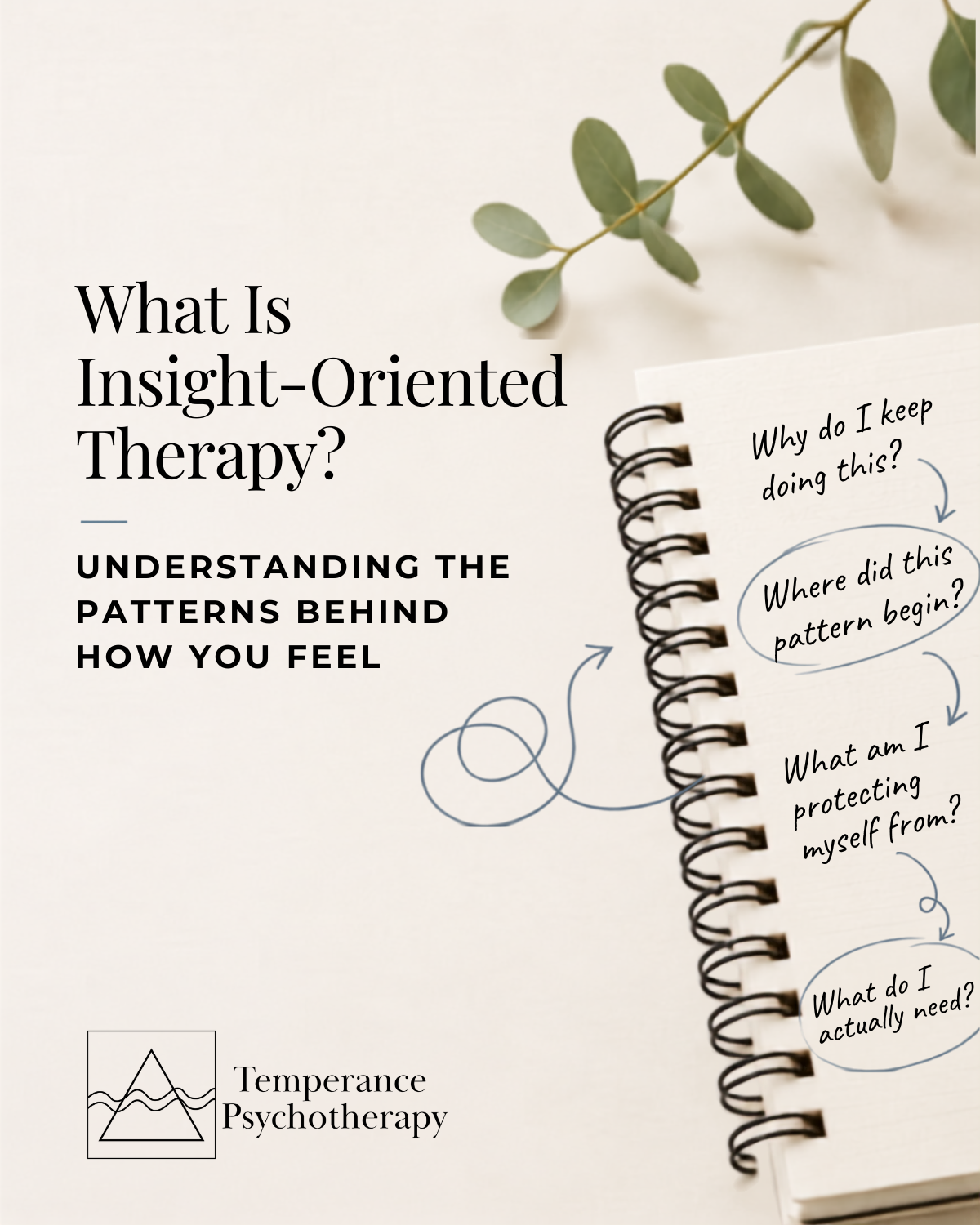
Insight-oriented therapy explores the deeper questions:
When did this pattern begin?
What feeling or outcome am I trying to avoid?
What does this reaction protect me from?
What beliefs about myself or other people are underneath it?
Why does this pattern continue even when I know it is not helping?
What happens emotionally when I try to respond differently?
The aim is not simply to label the pattern. It is to understand it well enough that change becomes possible.
How Do Patterns Develop?
Many emotional and relational patterns begin as adaptations.
A child who receives praise mainly for achievement may learn that being successful is the safest way to feel valued. Someone who grew up around unpredictable emotions may become highly attuned to other people's moods. A person whose needs were dismissed may learn to minimize those needs or feel guilty for expressing them.
These responses can be intelligent ways of navigating earlier circumstances. The problem is that the brain may continue using the same strategy long after the original situation has changed.
For example:
An experience teaches you that mistakes lead to criticism or rejection.
You develop perfectionism to reduce that risk.
Perfectionism brings temporary relief or approval.
Over time, the pattern becomes automatic.
As an adult, even small mistakes trigger intense anxiety or shame.
Insight-oriented therapy helps you notice that cycle with compassion rather than judgment.
What Happens During Insight-Oriented Therapy?
Sessions often feel like a thoughtful, focused conversation. You and your therapist may explore current stressors while also paying attention to recurring themes, emotional reactions, relationship patterns, and earlier experiences that help make sense of them.
Your therapist may:
Ask questions that help you look beneath your first explanation
Point out themes or patterns appearing across different situations
Help you identify emotions that are difficult to name or tolerate
Explore how earlier relationships shaped your expectations of yourself and others
Notice ways you protect yourself, such as avoidance, humor, intellectualizing, perfectionism, or people-pleasing
Pay attention to patterns that show up within the therapeutic relationship
Help you connect insight with different choices outside of sessions
There is no single script. Good insight-oriented therapy is collaborative and responsive to what feels most relevant to you.
Is Insight-Oriented Therapy Only About Childhood?
No.
Your early experiences can be important because they often shape your first beliefs about safety, connection, emotions, and self-worth. However, insight-oriented therapy is not about blaming your parents or assuming every current problem comes from childhood.
Therapy may also explore:
Current relationships
Cultural and family expectations
Major life transitions
Experiences of trauma, loss, rejection, or instability
Social pressures and identity
Present-day coping strategies
What happens between you and your therapist in real time
The past is explored when it helps make the present more understandable—not simply for the sake of revisiting it.
What Can Insight-Oriented Therapy Help With?
Insight-oriented therapy may be helpful for people experiencing:
Anxiety or chronic overthinking
Depression or persistent low self-worth
Perfectionism and fear of failure
People-pleasing and difficulty setting boundaries
Relationship difficulties
Shame, guilt, or harsh self-criticism
Repeated patterns that feel difficult to change
Difficulty identifying or expressing emotions
Life transitions or questions about identity
Trauma-related patterns, when approached safely and appropriately
It can also be valuable for someone who appears to be functioning well on the outside but feels disconnected, unfulfilled, or unsure why life continues to feel so difficult internally.
Is Insight Alone Enough to Create Change?
Not always.
Understanding why you do something does not automatically make it easy to stop. You can have a great deal of self-awareness and still feel anxious, avoid difficult situations, or repeat a familiar coping response.
That is why insight-oriented therapy is often most useful when insight is connected to action.
Once a pattern becomes clearer, therapy may help you:
Notice it earlier
Tolerate the emotions that usually activate it
Question long-standing assumptions
Practice communicating more directly
Set boundaries
Respond with greater self-compassion
Experiment with a new behavior
Insight helps explain the pattern. Practice helps change it.
Is Insight-Oriented Therapy the Same as Psychodynamic Therapy?
The terms are related and sometimes used interchangeably.
Psychodynamic therapy is a broad therapeutic tradition that examines how unconscious processes, past experiences, internal conflicts, and relationships influence present functioning. Insight-oriented therapy draws heavily from these ideas and emphasizes developing greater awareness of the forces shaping your thoughts, feelings, and behavior.
In practice, some therapists use “insight-oriented” more broadly to describe an exploratory style that may also incorporate approaches such as attachment-based therapy, cognitive behavioral therapy (CBT), dialectical behavior therapy (DBT), or mindfulness.
The exact experience depends on the therapist and your treatment goals.
How Is Insight-Oriented Therapy Different From CBT?
CBT often focuses on the relationship among current thoughts, feelings, and behaviors. It may involve identifying unhelpful thinking patterns, learning skills, and practicing new responses.
Insight-oriented therapy tends to spend more time exploring how and why a pattern developed, what emotional purpose it serves, and how it appears across different areas of your life.
Neither approach has to exclude the other.
For example, you might use CBT strategies to challenge the thought, “If I disappoint someone, they will reject me,” while using insight-oriented therapy to understand why disapproval feels so threatening in the first place.
Many therapists integrate both: practical tools can help you function differently now, while insight supports deeper and more lasting change.
What Is the Therapeutic Relationship’s Role?
The relationship between you and your therapist is an important part of insight-oriented work.
Patterns that occur elsewhere may eventually appear in therapy. You might worry about disappointing your therapist, minimize your needs, expect criticism, avoid disagreement, or feel pressure to be the “perfect” client.
When these moments are explored with care, therapy becomes a safe place to understand the pattern as it happens and practice a different experience.
This does not mean every interaction is overanalyzed. It means the therapeutic relationship can offer useful information about how you relate to yourself and others.
How Long Does Insight-Oriented Therapy Take?
There is no universal timeline.
Some people use insight-oriented therapy for a focused concern over several months. Others choose longer-term work when patterns are deeply rooted, affect many parts of life, or involve longstanding relationship and self-worth concerns.
The length of therapy may depend on:
Your goals
The complexity and duration of your concerns
How often you attend sessions
Whether you are also working on specific behavioral skills
What feels helpful and sustainable for you
You and your therapist should revisit your progress and goals rather than assuming therapy must continue indefinitely.
Frequently Asked Questions
-
No. You do not need a detailed memory of your childhood for insight-oriented therapy to be useful. Therapy can begin with what is happening in your life now and explore earlier experiences only when they feel relevant.
-
A therapist may offer observations or possible connections, but insight should be developed collaboratively—not imposed on you as a definitive interpretation. You are the expert on your own experience.
-
Insight-oriented therapy overlaps substantially with psychodynamic psychotherapy. Research reviews have found psychodynamic therapies helpful for a range of common mental-health concerns, although the best approach depends on the individual, diagnosis, goals, and quality of the therapeutic relationship.
-
Yes, when the approach is adapted to their developmental level. With younger clients, insight may develop through play, creative activities, storytelling, and conversations about feelings and relationships rather than through abstract analysis alone. Parent involvement may also be helpful.
-
Yes. It can be integrated with CBT, DBT, exposure and response prevention (ERP), mindfulness, and other approaches. For example, someone with OCD may use ERP to directly interrupt the OCD cycle while using insight-oriented exploration for separate concerns involving identity, relationships, grief, or self-criticism. Insight should not replace a disorder-specific treatment when one is indicated.
Is Insight-Oriented Therapy Right for Me?
Insight-oriented therapy may be a good fit if you want more than immediate symptom-management tools and find yourself asking questions such as:
“Why do I keep reacting this way?”
“Why do I understand the pattern but still feel unable to change it?”
“Why am I so much more compassionate toward everyone else than toward myself?”
“Why do the same problems keep showing up in different relationships?”
“Who am I when I am not trying to meet everyone else's expectations?”
You do not need to arrive with those answers. Therapy is where you begin exploring them.
Ready to Understand Yourself More Deeply?
You may have developed certain patterns for understandable reasons. Recognizing that does not mean you have to remain stuck in them.
At Temperance Psychotherapy, I use insight-oriented therapy alongside evidence-based approaches to help children, teens, and adults better understand the patterns affecting their emotions, relationships, self-image, and daily lives. I offer in-person therapy in Longwood and Maitland, Florida, as well as virtual therapy throughout Florida, New Jersey, and Vermont.
If you are ready to become more curious about what is beneath the surface—and begin making choices that feel more aligned with who you are—I would love to help.
Sources
The information in this article is based on current research and established clinical practice. To learn more about psychodynamic and insight-oriented therapy, these resources provide additional information:
